Reimagining financial planning for 3.3M monthly Chase customers
March 2022 - September 2025
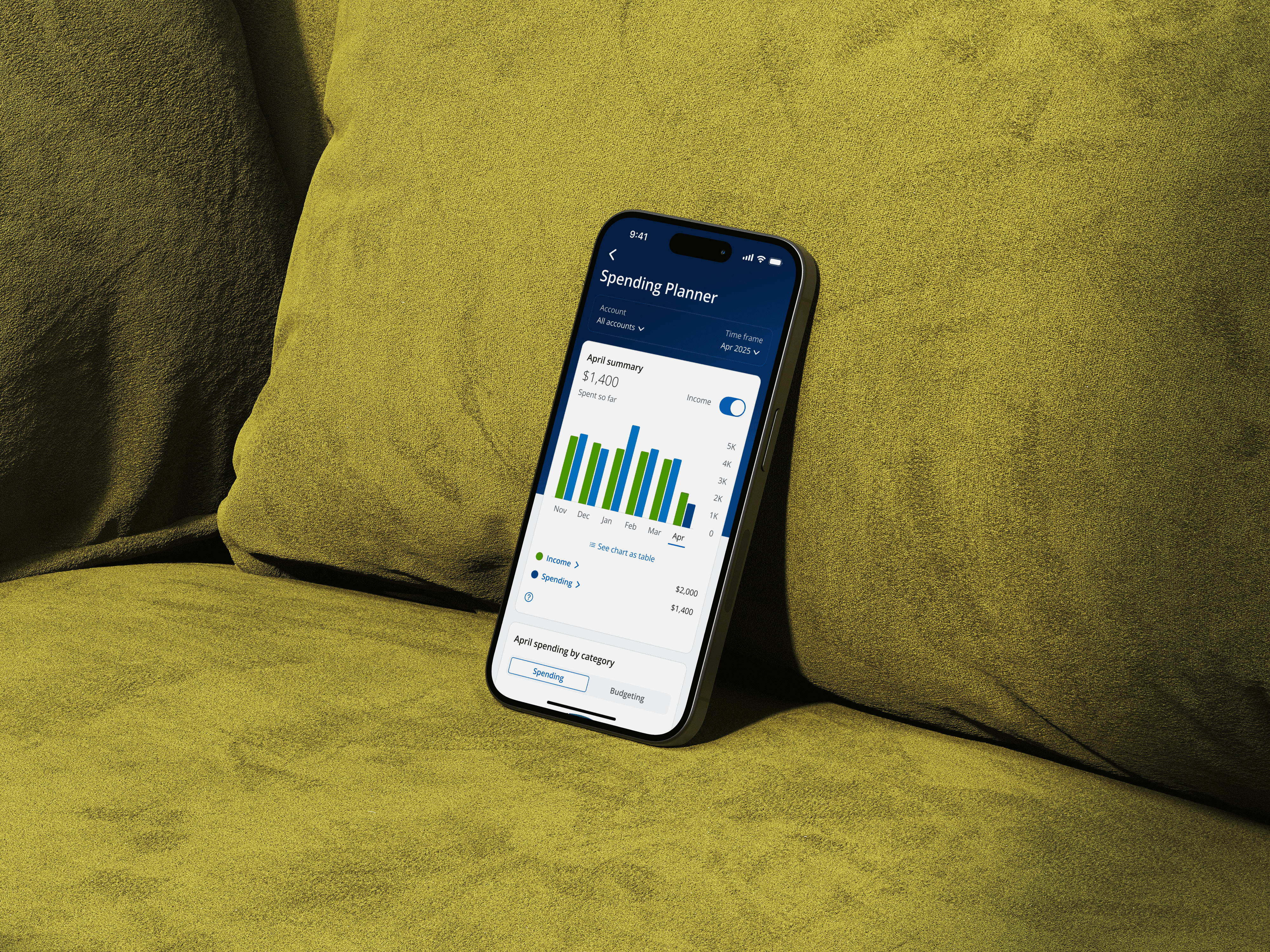
Launched
I helped transform Chase's spending and budgeting experience from a collection of disconnected tools into a financial planning platform used by 3.3M monthly customers.
Overview
Problem
Spending Planner was one of Chase's core financial wellness experiences, but the product was fragmented. Spending Summary and Budget existed as separate tools, making it difficult for customers to understand spending patterns, take action, and build lasting financial habits. Despite serving over 1.6 million monthly active users, satisfaction and engagement remained low.
Solution
Over multiple years, I helped evolve Spending Planner from a collection of disconnected financial tools into a more comprehensive financial planning platform. I improved spending visibility through redesigned data visualizations, increased customer control through budgeting and transaction management capabilities, expanded discoverability across the Chase ecosystem, and explored AI-generated insights to reduce the effort required to understand financial behavior.
Impact
1.6M → 3.3M
Increase in monthly active users
27% → 51%
Increase in customer satisfaction
21% → 27%
Increase in retention
Context
The product was failing, and it wasn't just a UX problem
Chase customers had access to spending insights, budgets, and transaction data, but thesis tools lived as separate experiences and did not work together as a cohesive planning system.
Spending Summary helped customers understand where their money went, while Budget helped them set limits. But the experience was fragmented: customers had to switch between tools, interpret static charts, and manually connect insights to action. As a result, the product was useful for looking backward, but less effective at helping customers make better financial decisions going forward.
This created a broader product problem: how might we turn Chase’s spending tools from passive reporting into a more connected planning experience that helps customers understand, control, and act on their spending?
Spending summary in 2022
Budget tool in 2022
Why this matters?
Spending Planner sat at the center of Chase's financial health ecosystem. For many customers, it was one of the few places where they could regularly review their spending habits, track progress toward financial goals, and build awareness of their overall financial picture. The experience also served as a foundation for future planning, savings, and personalized financial guidance.
As customer expectations for financial tools continued to rise, improving the experience became increasingly important—not only for helping customers make better financial decisions, but also for strengthening engagement and long-term relationships with Chase.
The cost of fragmentation
Despite serving over 1.6 million monthly active users, the experience struggled to drive sustained engagement.
Customer feedback consistently pointed to the same issues: spending information felt incomplete, budgeting required too much manual effort, and customers often had difficulty translating insights into meaningful actions. As a result, satisfaction remained low and many customers did not return after their initial visits.
The fragmented experience limited both customer value and business impact. Customers lacked the confidence to actively manage their finances, while Chase missed opportunities to deepen engagement and become a more trusted financial partner.
Our approach
A long-term product evolution
Rather than treating Spending Planner as a single redesign effort, we viewed it as a long-term product evolution.
Research revealed that customers faced multiple layers of friction. Many struggled to understand their spending patterns, lacked confidence in the accuracy of their financial data, rarely revisited the experience after their initial visit, and often needed help identifying meaningful actions to take.
These findings led us to define a four-phase product strategy:
01
Help customers understand their finances through clearer visualizations and insights.
02
Give customers more control over their financial data and planning tools.
03
Deepen engagement by integrating Spending Planner into the broader Chase ecosystem.
04
Move beyond reporting by providing personalized and AI-powered financial guidance.
This framework helped us prioritize opportunities, align stakeholders, and ensure each release built toward a larger product vision.
Phase 1 — Building understanding
Redesigning data visualizations
The first challenge was helping customers make sense of their financial data.
Through customer interviews and feedback analysis, we found that many users could access spending information but struggled to interpret it. Existing visualizations provided large amounts of transactional data, yet often lacked the context needed to identify meaningful patterns. Customers could see what they spent, but not how it compared to their income, or which merchants were driving their largest expenses.
This created an important gap in the experience. Before customers could budget, adjust their behavior, or take action, they first needed to understand their financial habits.
To improve comprehension, I led the redesign of several key data visualizations across Spending Planner. Rather than focusing solely on presenting more data, I prioritized clarity, comparison, and trend recognition. New visualizations helped customers understand spending patterns over time, compare income against expenses, and quickly identify areas of concern without manually interpreting individual transactions.
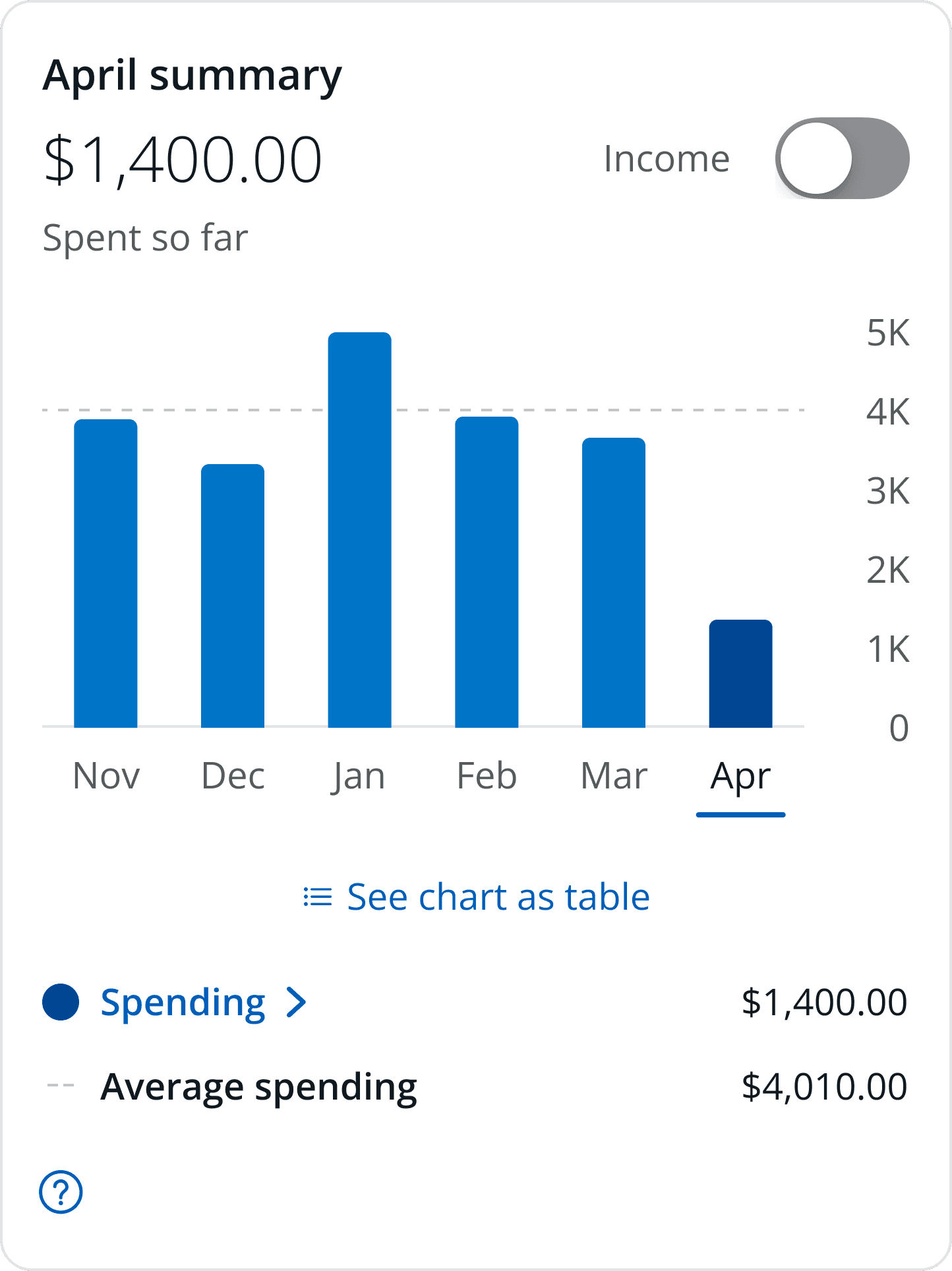
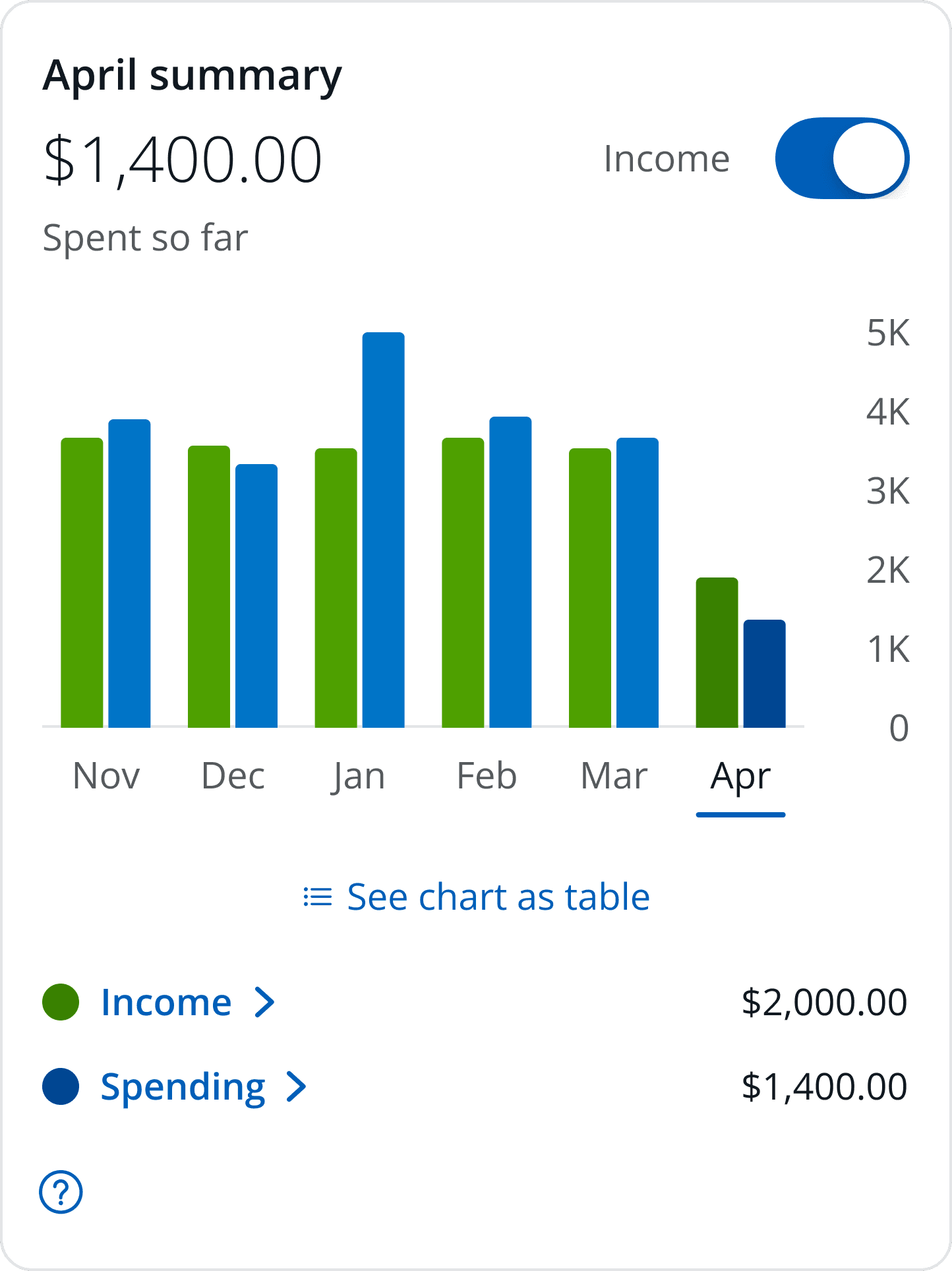
New data visualization
Merchant insights
At the same time, I introduced Merchant Insights, a new feature designed to surface spending at the merchant level. Research showed that customers often thought about spending in terms of brands and merchants rather than categories alone. While category-level insights helped answer “what” customers were spending on, merchant-level insights helped answer “where” their money was actually going. By highlighting frequently visited merchants and top spending destinations, I designed a more relatable and actionable view of spending behavior.

Merchant tile

Merchant dip screen
Together, these improvements established the foundation for the rest of the product. Customers could now move beyond reviewing transactions and begin developing a clearer understanding of their financial habits, creating the trust and awareness necessary for deeper planning experiences.
Phase 2 — Building control
Give users more control over their data
As customers gained a better understanding of their spending patterns, a new challenge emerged: understanding alone was not enough if customers could not trust or control the data behind it.
Research consistently revealed the same frustration. Customers often encountered transactions that were categorized incorrectly, spending patterns that did not accurately reflect their financial situation, and budgeting workflows that felt disconnected from their day-to-day spending activity. While Spending Planner helped customers observe their finances, it provided limited ways to shape or personalize the experience.
This lack of control created a trust problem. Even small inaccuracies could undermine confidence in the insights we surfaced. If customers felt the data was wrong, they were less likely to engage with budgeting tools or return to the experience over time.
To address this, I introduced several capabilities that gave customers greater ownership over their financial data. Customers could recategorize transactions when classifications were inaccurate, exclude transactions that distorted their spending picture, and create budgets through a simpler and more approachable workflow.
Recategorize and exclude transactions
Simplify budget creation flow
At the product level, I also recognized that Spending Summary and Budget were solving related problems but existed as separate experiences. Customers were expected to move between tools to understand their spending and take action on it. To reduce this friction, we gradually integrated Budget into Spending Summary, creating a more connected planning experience where insights and actions could live together.
Budget tab
Simplified budget creation flow
These changes represented an important shift in the product. Spending Planner was no longer just helping customers understand their finances—it was giving them the ability to shape, manage, and act on their financial data with greater confidence.
Phase 3 — Building engagement
Increase discoverability
By this point, Spending Planner had become significantly more useful. Customers could better understand their spending patterns, personalize their financial data, and take action through integrated budgeting tools. However, another challenge remained: many customers still weren't discovering the experience consistently.
Like many financial tools, Spending Planner often relied on intentional usage. Customers had to know it existed, actively seek it out, and remember to return. This created a disconnect between the value the product provided and the number of customers who actually benefited from it.
To address this, we shifted our focus from improving the experience itself to increasing its visibility across the broader Chase ecosystem. Rather than treating Spending Planner as a standalone destination, we looked for opportunities to integrate it into moments where customers were already engaging with their finances.
Working closely with cross-functional partners across multiple product areas, I designed new entry points through customer dashboards, financial wellness experiences, and other high-traffic surfaces. These integrations helped surface relevant spending information in context, reducing the effort required for customers to discover and revisit the product.

OVD dashboard entrypoint

Snapshot entrypoint
Monetization opportunity
As engagement grew, we also explored ways to connect spending behavior with broader financial opportunities. By linking Spending Planner to savings products, credit card recommendations, and merchant offers, we were able to create more relevant experiences for customers while supporting business objectives. Importantly, these opportunities were introduced only after the core planning experience had established sufficient customer value and trust.
Saving, credit card, and merchant offers
This phase marked a transition from product improvement to ecosystem integration. The goal was no longer simply helping customers manage their finances—it was ensuring the right financial guidance appeared at the right moment within their broader banking journey.
Phase 4 — Building intelligence
Personalized financial recommendations
While Spending Planner had become significantly more useful, we observed a new challenge: customers were still required to invest time and effort to interpret their financial information.
The experience now provided richer visualizations, budgeting tools, merchant insights, and personalized spending data. However, understanding financial behavior still required customers to actively explore charts, review transactions, and connect multiple pieces of information on their own.
This raised an important question: what if customers didn't need to analyze the data themselves?
Rather than asking users to spend several minutes reviewing their finances, I began exploring ways to surface the most important insights automatically. The goal was to help customers understand what changed, why it changed, and what actions they might consider—all within a few seconds.
This led to the exploration of AI-generated financial insights. Instead of presenting raw data alone, the experience could generate concise summaries that highlighted unusual spending patterns, significant month-over-month changes, recurring behaviors, or opportunities to improve financial health. For example, rather than requiring customers to review multiple charts, the product could proactively explain that dining expenses increased by 25% this month, primarily driven by more frequent restaurant purchases.
AI spending insights
The opportunity was not simply to provide more information, but to reduce the cognitive effort required to understand it. By helping customers quickly identify what matters most, we envisioned a future where Spending Planner could evolve from a reporting and planning tool into a more intelligent financial companion.
Web design
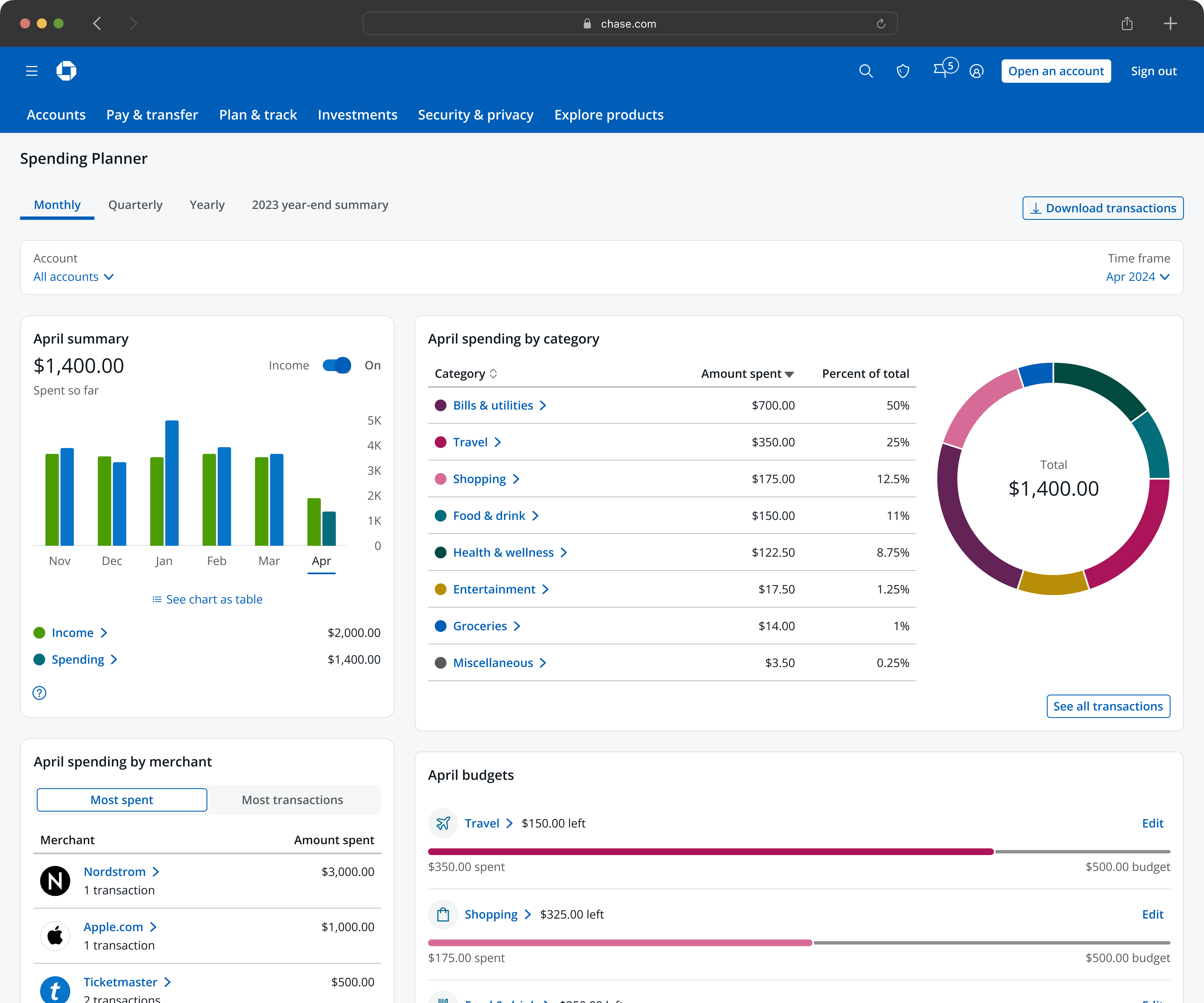
Web responsive design
Outcomes
Huge increase in business and customer metrics
Over several years, Spending Planner evolved from a collection of disconnected financial tools into one of Chase's most widely used financial wellness experiences.
By improving customers' ability to understand, control, and engage with their financial data, the product delivered meaningful gains across both customer and business metrics.
Customer satisfaction increased from 27% to 51%, reflecting stronger confidence in the experience and the value it provided. Monthly active users grew from 1.6 million to 3.3 million as improvements in discoverability and engagement encouraged more customers to return. Budget adoption also increased as planning workflows became more integrated and easier to use.
Beyond the metrics, the work established a foundation for future growth. The platform became better positioned to support personalization, financial guidance, and cross-product experiences across the broader Chase ecosystem.
The impact of the work was also recognized externally, contributing to Chase receiving the Fintech Breakthrough Award for Best Personal Finance Product in 2023.
My role in the transformation
Driving a multi-year product evolution
As one of the primary designers on Spending Planner, I helped shape the product's evolution over multiple years, from improving core financial experiences to defining future opportunities for engagement and personalization.
My role extended beyond designing individual features. I partnered closely with product managers to identify opportunities, prioritize initiatives, and align design decisions with both customer needs and business goals. I synthesized research findings, facilitated cross-functional discussions, and worked with engineering teams throughout implementation to ensure ideas could be successfully translated into shipped experiences.
Across the lifecycle of the product, I led design efforts for key initiatives including spending data visualization redesigns, budgeting experiences, financial planning workflows, merchant insights, discoverability improvements, and future AI-powered concepts. I also collaborated with Chase's design system team to improve accessibility, consistency, and scalability across mobile and web experiences.
Because Spending Planner evolved over several years, my role was not defined by a single launch. Instead, I helped guide a continuous product transformation—moving the experience from a collection of disconnected financial tools toward a more comprehensive financial planning platform.